
Yes—Invicta watches can be “good” if you buy the right collection, at the right price, with the right expectations. The brand’s best pieces deliver a lot of spec (reliable Seiko movement options, decent finishing for the money, and sometimes sapphire crystal) at prices many newcomers can justify. The catch is that Invicta’s loud design language, frequent sale markup, and wildly inflated RRP can make the value feel confusing—or worse, inconsistent—if you shop by list price or marketing photos alone.
My bottom line: Invicta is a 7/10 brand when purchased smartly, and closer to a 4/10 if you pay RRP and expect Swiss-luxury refinement. It’s best for buyers who want a bold, feature-heavy watch for casual wear, gifting, or a first “real” metal watch—and who aren’t chasing the quiet, artisanal vibe you’d associate with Patek (Patek Philippe) or FP Journe.
In this review, I’ll cover Invicta’s history, build & movements, design and sizing (including the oversized case era), pricing realities, and reputation. You’ll also see which models/lines—like the Invicta 7030 and the Signature collection—make the most sense.
Quick Specs / Overview
| Category | What to expect from Invicta |
|---|---|
| Brand heritage | Swiss roots; heritage (founded 1837), modern production is global/outsourced |
| Movements | Primarily quartz and affordable automatics; many models use a Seiko movement (e.g., NH35 family) |
| Crystals | Mix of mineral and sapphire crystal depending on model/line |
| Cases & bracelets | Stainless steel common; some gold plated stainless steel case options; bracelet quality varies |
| Design language | From traditional to loud; lots of homage / Rolex-inspired pieces and very large divers |
| Water resistance | Often marketed aggressively; real-world depends on gaskets/crown use and QC—treat as “splash-safe” unless tested |
| Typical street price | Often £60–£250 (US: $80–$300) for many popular models |
| Claimed RRP | Frequently much higher; can be hundreds to thousands—rarely the price you should pay |
Price point: Commonly £60–£250 on sale; some higher-end lines more
Rating: 7/10 (if bought at realistic sale prices)
What Is Invicta?
Invicta is a long-running watch name with a complicated modern identity. The brand was founded in 1837 in Switzerland, and that historic origin is real—but the current Invicta most shoppers know is a mass-market brand focused on high visual impact and aggressive pricing strategies. You’ll see everything from classic three-hand watches to brightly colored divers, skeletonized automatics, and big, sporty chronograph models.
The “problem” Invicta solves is simple: many people want a substantial, metal watch with plenty of wrist presence—often with features like rotating bezels, multi-link bracelets, and busy dials—without paying Swiss-luxury money. In that sense, Invicta competes more directly with fashion brands and entry-level Japanese brands than it does with true high horology. Nobody cross-shops Invicta with FP Journe on finishing; they cross-shop it on style, spec, and price.
The target audience is broad: first-time buyers, gift shoppers, collectors who like bold statement pieces, and enthusiasts who enjoy affordable homage / Rolex-inspired designs. If you’re comfortable treating it as fun, accessible watch culture rather than an heirloom purchase, Invicta can make a lot of sense.
Build Quality and Movements — What You Actually Get
Summary: Invicta’s best watches are genuinely solid for the money, especially those with known Japanese calibres, but quality can vary by line and by individual piece.
Invicta’s strongest practical advantage is movement choice on many models: you’ll often find a reliable Seiko movement in their automatics (commonly from the NH family), plus straightforward quartz options that are cheap to service and easy to live with. In day-to-day wear, a Seiko-based Invicta tends to be predictable: it starts easily, keeps acceptable time for an entry-level automatic, and doesn’t feel “temperamental” the way some bargain no-name movements can.
Casework is typically stainless steel, and the better references feel properly hefty, with decent brushing/polishing separation and acceptable tolerances around the crown and bezel. But this is also where variance shows: the same model can feel great in one sample and slightly rough around the edges in another—sharp bracelet edges, inconsistent bezel action, or a clasp that feels thinner than you’d expect from the weight of the head.
Compared to alternatives: Against budget microbrands using Seiko NH35, Invicta often wins on “spec for the sale price” but loses on consistency and design restraint. Against Seiko-branded watches, you’ll often get less refined bracelets/dials at similar money—unless you buy Invicta at a deep discount.
Takeaway: Look for known movement families and inspect the bracelet/clasp quality—those two factors decide whether an Invicta feels like a bargain or merely busy.
Crystals, Cases, and Bracelets — Where the Value Shows
Summary: Some Invictas over-deliver on materials (including sapphire crystal), but you need to check the specific reference—Invicta mixes mineral and sapphire across the catalog.
If you’re shopping Invicta, don’t assume the crystal. Many entry pieces use mineral glass, which is fine for daily wear but will pick up scratches faster than sapphire. The nicer buys—often within lines that are positioned as more “serious”—feature sapphire crystal, which is a meaningful upgrade at the prices Invicta frequently sells for. Sapphire won’t make the watch more accurate, but it will keep it looking new far longer if you’re not careful with door frames and desk edges.
Case materials are usually stainless steel, sometimes in a gold plated stainless steel case. Plating can look great out of the box—especially on yellow gold tone pieces—but it’s not magic. If you wear it hard, expect wear to show on high-contact edges. Bracelet construction also ranges from hollow-feeling links to genuinely decent solid links on better references. Solid links matter: they reduce rattling, improve drape, and make the watch feel more “real” on wrist.
Compared to alternatives: At full RRP, you can often find a better-finished bracelet from Citizen or Seiko. At common sale prices, getting sapphire and solid links together is where Invicta can beat the mainstream.
Takeaway: For value, prioritize models that combine sapphire crystal + solid links—those two details do more for long-term satisfaction than another sub-dial.
Design, Sizing, and Branding — The Oversized Case Era
Summary: Invicta’s biggest weakness is also its signature: loud designs, frequent oversized case proportions, and sometimes aggressive branding (including large “Invicta” engraving on the case side).
There’s no way around it—Invicta’s modern reputation is tied to big, attention-grabbing watches. Some of that is fun. A chunky diver or chronograph can be a confident weekend watch. But a lot of models push beyond “bold” into “hard to wear,” especially if you have smaller wrists or want something that disappears under a cuff. The brand’s shift toward oversized designs is a real criticism, and the prominent case-side engraving can feel more like billboard advertising than tasteful identity.
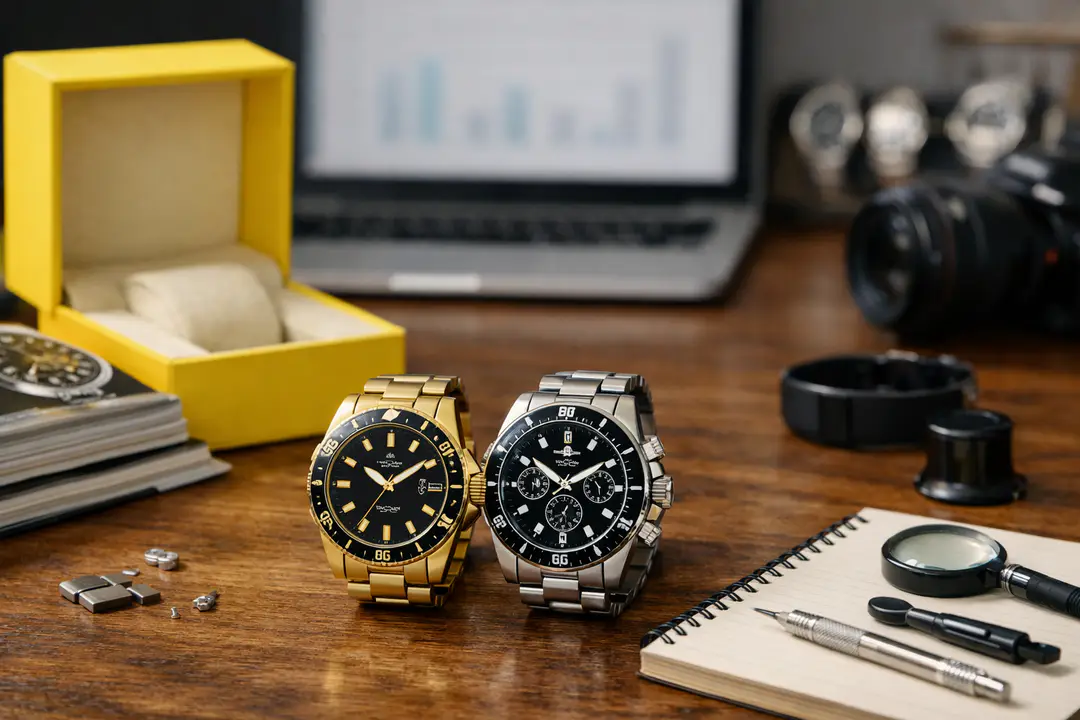
That said, Invicta does make more wearable pieces if you look beyond the loudest Pro Diver variants and the largest Subaqua-style cases. The often-cited example is the Invicta 7030, which a user described as a yellow gold chronograph that still fits a 6-inch wrist. In that configuration—gold plated stainless steel case, sapphire crystal, solid links, and a Seiko movement—it’s proof Invicta can do “flashy but practical.”
Compared to alternatives: Brands like Orient and Seiko tend to offer more cohesive design language and better sizing discipline. Invicta offers more variety (and often more spectacle) for less money.
Takeaway: If you dislike loud branding or massive proportions, filter Invicta aggressively by diameter, lug-to-lug, and photos of the case side before buying.
Homage / Rolex-Inspired Models — Style vs. Originality
Summary: Invicta is a major player in the homage / Rolex-inspired space; whether that’s a pro or con depends on your values and why you wear a watch.
Invicta’s Pro Diver-style designs are often discussed in the same breath as Rolex aesthetics—especially Submariner cues (dial layout, bezel style, oyster-style bracelets). If you like the general look but don’t want to spend Rolex money (or even Seiko money), Invicta can scratch that itch. The upside is clear: you can get a familiar silhouette, sometimes an automatic movement, and a hefty bracelet for a fraction of the cost.
The downside is equally clear: if you care about originality, some Invicta designs won’t feel like a proud expression of the brand. You also need to separate “inspired by” from “trying too hard.” On wrist, details like oversized logos, extra text, or shiny finishing can move a watch from “classic diver” to “costume-ish,” especially next to more restrained alternatives.
Compared to alternatives: Steeldive/San Martin-style homage brands can offer better finishing per pound but with weaker brand recognition and less retail presence. Seiko and Orient offer their own DNA, though often at higher prices for comparable specs.
Takeaway: If you want the Rolex-adjacent look on a budget, Invicta can work—just choose a reference with minimal dial clutter and sensible sizing.
Signature Collection — “Traditional Watches” Done Right?
Summary: The Signature collection is where Invicta’s promise makes the most sense: “traditional watches of high quality for a good price,” generally with fewer design excesses.
Invicta’s catalogue is vast, but the Signature line is often positioned as the calmer corner—less cartoonishly large, more classic case shapes, and more wearable dial designs. When people say Invicta can be “surprisingly good,” they’re usually talking about watches that lean this direction: cleaner indices, simpler bezels, and finishes that don’t try to do five different things at once.
In practical use, Signature pieces tend to wear better and feel less like they’re fighting for attention. That matters: a watch you can throw on without planning an outfit is the watch you actually wear. Depending on the specific reference, you may still see variation in bracelet quality and clasp feel, but overall the value proposition is easier to defend—especially when bought on discount rather than at stated RRP.
Compared to alternatives: At similar street prices, Citizen and Seiko often provide more consistent QC and aftersales. Signature can still win if you want heavier metal presence, and you find a model with sapphire and solid links.
Takeaway: If you’re Invicta-curious but wary of the oversized, loud stuff, start with the Signature collection and you’ll see the brand at its most sensible.
Pricing, RRP, and the Frequent “Sale” Strategy
Summary: Invicta’s pricing is the single biggest reason buyers feel either delighted or burned; treat RRP as a marketing number and shop the street price.
Invicta is notorious for big, dramatic discounts—watches “marked down” from a very high RRP to a price that seems irresistible. The issue isn’t that discounts exist; it’s that the sale markup pattern can make shoppers believe they’re getting a luxury product for pennies, when in reality the sale price is closer to the watch’s normal market value. If you pay the inflated list price, the value equation collapses quickly.
Here’s the practical approach: decide what the watch is worth to you based on specs (movement, crystal, bracelet) and execution (finishing, design), then compare it to realistic competitors at that same price. Invicta looks much better at £80–£200 than it does at “was £900, now £149.”
Also remember resale: most Invictas do not hold value, which is totally fine if you’re buying to wear. But it means you should be extra disciplined about what you pay.
Compared to alternatives: Microbrands often price more transparently (fewer fake “slashes”), but don’t always offer the same retail availability or visual variety.
Takeaway: The right way to buy Invicta is to ignore RRP, shop discounts, and judge against competitors at the actual price you’re paying.
Water Resistance and Real-World Durability
Summary: Invicta often advertises strong water resistance, but real-world confidence depends on QC and how you use the crown/pushers—so be conservative.
Many Invicta divers and sport watches are labeled with impressive numbers (100m, 200m, sometimes higher). The honest truth: a rating on the dial isn’t the same as a pressure test on the watch you received. If your watch has a screw-down crown, treat it properly—always ensure it’s threaded down before exposure. For chronograph models, avoid using pushers in water unless the watch is specifically designed for it.
In normal life—washing hands, rain, accidental splashes—most Invictas hold up fine. The bigger risk is assuming every “200m” Invicta is ready for regular swimming without ever having its seals checked. That’s not unique to Invicta; it’s just more important with budget watches where QC variance can be a thing.
Compared to alternatives: Seiko and Citizen often inspire a bit more confidence for “set and forget” water use, largely due to consistency and long-standing dive-watch know-how. Invicta can still be okay if you treat the rating as a guideline, not a dare.
Takeaway: For water activities, either get the watch pressure-tested or choose a proven alternative; for everyday splashes, Invicta is usually fine.
Customer Service, Reputation, and Buying Confidence
Summary: Invicta’s reputation is polarized: fans love the spec-for-money; critics dislike the design direction and pricing theatrics. Service experiences vary.
Brand reputation matters because it affects expectations. Invicta isn’t trying to be Patek (Patek Philippe) or FP Journe—brands where finishing, movement architecture, and after-sales stewardship are part of the product. Invicta’s identity is closer to “big look, big spec sheet, accessible price.” When buyers judge it by luxury standards, disappointment is predictable.
Customer service and warranty handling are harder to generalize. Some owners report straightforward outcomes; others find turnaround slow or communication limited, especially when the watch was bought through third parties. The safest play is to buy from a retailer with a clear return window, inspect the watch immediately (alignment, bezel action, clasp, timekeeping), and keep documentation.
If you’re the type who obsesses over perfect chapter-ring alignment or flawless bracelet finishing, Invicta can test your patience. If you’re okay with minor quirks in exchange for design punch and features at a low street price, you’ll likely be satisfied.
Takeaway: Buy from a seller with easy returns, inspect carefully on day one, and set expectations to “budget enthusiast” rather than “future heirloom.”
Best Invicta Models to Consider (and Why)
Summary: The smartest Invicta purchases are the ones that balance wearable sizing, proven movements, and meaningful materials like sapphire and solid-link bracelets.
| Model/Line | Why it’s worth considering | Who it’s for |
|---|---|---|
| Invicta 7030 | Often cited with sapphire crystal, gold plated stainless steel case, solid links, and a Seiko movement; wearable even on a 6-inch wrist in reported use | Want a flashy yellow gold chronograph that still fits smaller wrists |
| Signature collection | More traditional styling; better chance of finding “daily wearable” proportions and calmer dials | Want Invicta value without the loudest design choices |
| Pro Diver (select references) | Classic diver silhouette; often the best of Invicta’s homage / Rolex-inspired options if you pick a clean dial | Want the familiar diver look on a budget |
One practical tip: if you’re tempted by an oversized case model, look up lug-to-lug measurements and real wrist shots. Case diameter alone doesn’t tell you whether it will overhang or sit comfortably.
Takeaway: Choose a specific reference for specs and wearability—not “Invicta” in general—and the brand makes more sense.
Pros and Cons
Pros
- Strong specs at real-world prices: At typical sale pricing, you can get features (like sapphire crystal) that are uncommon at the same cost elsewhere.
- Reliable movement options: Many models use a known Seiko movement, which is familiar to watchmakers and generally dependable.
- Big wrist presence: If you like bold watches, Invicta’s sporty designs and heft are part of the appeal.
- Some surprisingly wearable models exist: Examples like the Invicta 7030 show the brand can do flashy without being unwearable.
- Lots of variety: Divers, dressier pieces, skeleton styles, and chronograph watches give new buyers plenty to explore.
Cons
- Pricing theatrics: Inflated RRP and frequent sale markup can confuse buyers and distort perceived value.
- Inconsistent finishing/QC: Bracelet edges, bezel feel, and alignment can vary more than with Seiko/Citizen at similar money.
- Branding can be excessive: Large case-side engravings and loud logos aren’t for everyone.
- Oversized tendencies: Many popular models use an oversized case that can overwhelm smaller wrists and limit versatility.
- Weak resale value: Most models depreciate heavily, so paying near list price is hard to justify.
Pricing and Value
Most Invicta watches are “worth it” only at the price people actually pay, not the price on the tag. In the UK, it’s common to find attractive models around £60–£250, with some higher depending on materials and complications like a chronograph. At those numbers, getting a familiar automatic (often a Seiko movement), a heavy bracelet, and sometimes sapphire crystal can be genuinely satisfying.
Compared with Seiko, Citizen, and Orient at similar street prices, Invicta often gives you more visual drama and sometimes better paper specs, but usually less refined finishing and less predictable quality control. Compared to microbrands, Invicta can be cheaper and easier to find, but microbrands tend to be more transparent about pricing and design intent.
Value verdict: Strong value on discount; questionable value at RRP.
Who Should Buy This
Invicta is a good choice if you want a bold, metal watch with real weight, you enjoy sporty styling, and you’re shopping with a firm budget ceiling based on street prices. It’s also a solid pick if you want an affordable entry into automatic watches—especially if you choose a model with a known Seiko movement and a more restrained design (often in the Signature collection).
You should skip Invicta if you’re sensitive to design excess (big logos, flashy finishing), if you dislike the brand’s sale markup culture, or if you want a “one watch” that works in every setting. Also skip if you plan to swim regularly and don’t want to think about pressure testing; in that case, a more consistently executed diver from Seiko or Citizen may be the calmer choice.
One-line guidance: Buy Invicta for fun, presence, and value—don’t buy it to impress watch snobs.
Final Verdict — Are Invicta Watches Good?
Overall rating: 7/10 (when bought at realistic sale pricing and chosen carefully).
Invicta is good at one thing: delivering a lot of watch for not much money—sometimes with legitimately desirable details like sapphire crystal, solid links, and a dependable Seiko movement. The brand loses points for inconsistent finishing, polarizing design choices, and the confusing gap between RRP and true market price. If you pick a sensible reference—like the often-discussed Invicta 7030 or a cleaner Signature collection piece—you can end up with a watch you enjoy wearing daily.
Best alternatives: If you want more consistent QC and understated design, look at Seiko 5 Sports, Citizen Promaster (for water-focused use), or Orient for classic Japanese value. If you want an homage with sharper finishing, consider reputable microbrands—just expect less mainstream retail presence.
Buying Tips (New, Sale, or Secondhand)
Summary: The “smart” Invicta purchase is about retailer choice, return policies, and spec verification—not chasing the biggest discount banner.
- Ignore RRP: Use street price comparisons. If it’s only a good deal “because it’s 90% off,” be cautious.
- Prioritize key specs: Choose sapphire crystal where possible, and prefer bracelets with solid links.
- Check sizing beyond diameter: Lug-to-lug and thickness matter most, especially with an oversized case.
- Inspect immediately: Look for alignment issues, clasp play, bezel action, and crown threading on day one.
- Secondhand can be smart: Because resale is soft, lightly used Invictas can be excellent value—if you buy from a trusted platform.
A Note on Expectations (and Why This Matters)
It helps to put Invicta in the right mental category. If your benchmark is high horology—say, the finishing philosophy and movement artistry you’d associate with Patek (Patek Philippe) or FP Journe—Invicta won’t satisfy you, and it’s not trying to. If your benchmark is “I want a fun, robust-looking watch that won’t make me nervous to wear,” Invicta can be a very rational choice.
And if you’re building a broader lifestyle of practical purchases—where you compare what you get versus what you pay—the same mindset that applies to evaluating everyday modern living choices applies here: clear needs, honest budgets, and a little skepticism about marketing numbers tend to lead to better buys.
Related Reading (Internal)
If you’re curious how broader tech and consumer trends shape what brands prioritize—materials, online sales funnels, and pricing psychology—it’s worth keeping an eye on how AI is changing consumer experiences. And if you’re the type who likes tracking what’s next in the hobby, you may enjoy this roundup of upcoming releases and watch trends as context for where entry-level brands are heading.